
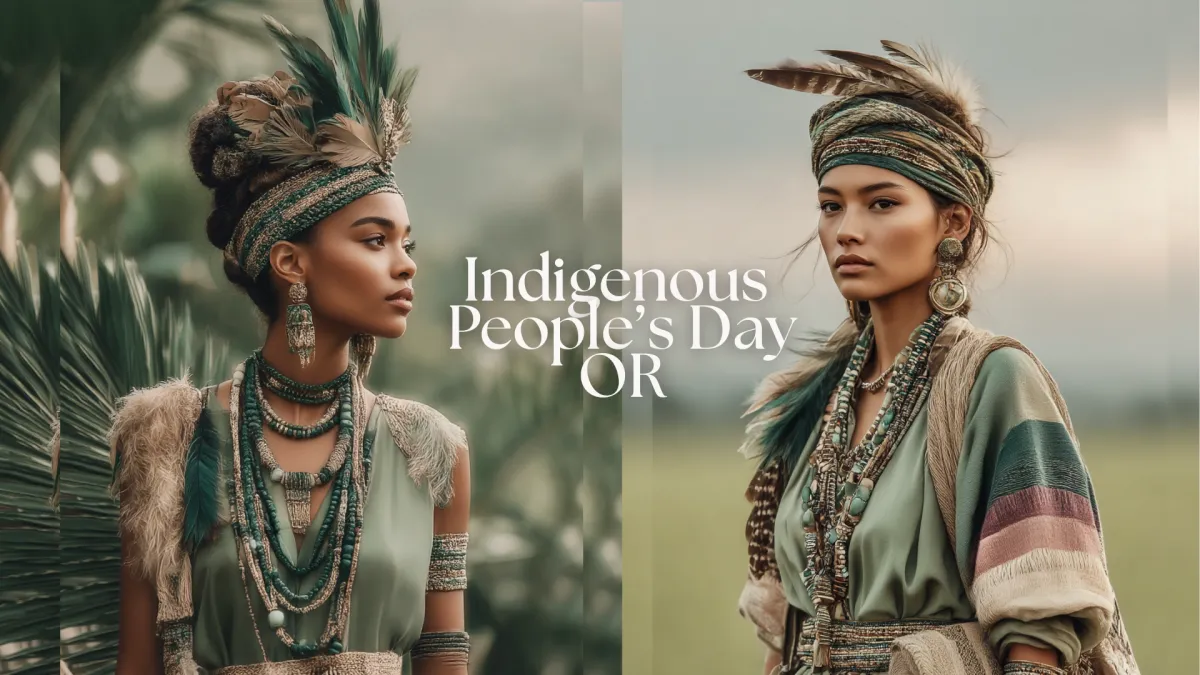
Indigenous People's Day or Columbus Day, Why We Need to Remember
Honoring Indigenous Peoples: Remembering the Truth Behind the Narrative

Today, we honor the Indigenous people—the original stewards of this land—and the ancestors who endured unimaginable pain, displacement, and loss. We honor their resilience, wisdom, and deep spiritual connection to the Earth that continues to guide and teach us.
And as we remember them, we must also look at how this part of history was shaped, marketed, and sold to the world. And notice when these tactics are used again.
Because while Indigenous peoples were stripped of their land, families, and freedom, Cristoforo Colombo—known to most as Christopher Columbus—was celebrated as a hero.
But how did a man who raped, pillaged, and enslaved entire populations become immortalized as a symbol of exploration and courage?
The answer lies not just in history—but in the power of branding, narrative, and propaganda.
The Myth of the “Great Explorer”

Columbus wasn’t just a navigator. He was one of history’s earliest masters of personal branding.
He knew how to craft a story, sell an idea, and position himself as a visionary long before “marketing” existed as a profession. His voyage wasn’t just a mission of discovery—it was a masterclass in strategic storytelling, political influence, and image manipulation.
⚜️ 1. Strategic Storytelling & Myth-Making
Columbus pitched a bold, controversial idea: that he could reach Asia by sailing west. Despite being wrong, he presented his vision with charisma and conviction. He claimed divine inspiration, promising Spain wealth, expansion, and spiritual conquest.
He created a myth, not a mission. And in doing so, he turned skepticism into sponsorship. And of course, we advise against this, and pay attention when it's presented. Use your discernment.
⚜️ 2. Leveraging the Power of the Narrative
When Columbus arrived in lands already inhabited by thriving Indigenous civilizations, he branded them as “discovered.”
This is where the danger of one-sided storytelling begins—when power controls the narrative, truth is erased.
His letters back to Spain described opportunity, not oppression. Abundance, not brutality. These reports were the 15th-century equivalent of a PR campaign—published, translated, and spread throughout Europe.
He was hailed a hero not for what he did, but for how he told the story.
⚜️ 3. Symbols, Naming, and Visual Branding
Columbus planted flags, renamed islands, and infused religious symbolism into every act of conquest. “San Salvador,” “La Navidad”—these names gave divine justification to imperialism, cloaking domination in the language of holiness.
It was branding, not benevolence.

History Written by the Victors
We were taught in school that Columbus “discovered” America. But what about the people who were already here?
What about the civilizations, languages, medicines, and traditions that were lost?
What about the women, children, and men who were enslaved or massacred?
History, as we were told, was edited—curated by the victors.
But let’s be honest: the victors were often the ones who conquered, killed, or silenced others.
And if we erase this part of history, we risk repeating it.
The Mirror of Modern Times
The same tactics Columbus used—storytelling, fear, manipulation, and strategic alliances—are still at play today in politics, the media, and global economics.
We are watching similar “marketing campaigns” unfold in real time. Narratives of conquest and control rebranded as progress and freedom.
This is why remembering matters.
Because when we forget, we become blind to the patterns repeating themselves before our eyes.

Honoring Truth, Healing the Future
We can’t change what happened.
But we can change how we remember it.
We can choose to speak truth, even when it’s uncomfortable.
We can honor Indigenous people not only through acknowledgment but also through action, allyship, and awareness.
We can learn from the manipulation of history to ensure we never allow a false narrative to erase humanity again.
We do not need to take from others to live.
We can co-exist—in peace, in reverence, and in truth.
Closing Reflection
As a marketer, I find it crucial to remember that storytelling is powerful. It shapes perception, defines legacies, and can either illuminate truth or disguise destruction.
Columbus didn’t just “discover” new lands—he branded them.
And that branding changed the world—for better and for worse.
Let’s learn from this. Let’s speak with integrity. Let’s ensure our collective “marketing” of history, humanity, and progress reflects truth—not illusion.
Because when we stand in truth, we honor not just the past—but the future we are capable of creating together.
✨ With reverence for truth, healing, and awakening,
Farhana Cannon
Founder, iMedia Exposure & The Divine Brand Collective
